
Welcome to the Mathematical World!
Leonhard Euler
One of History’s Most Prolific Mathematicians
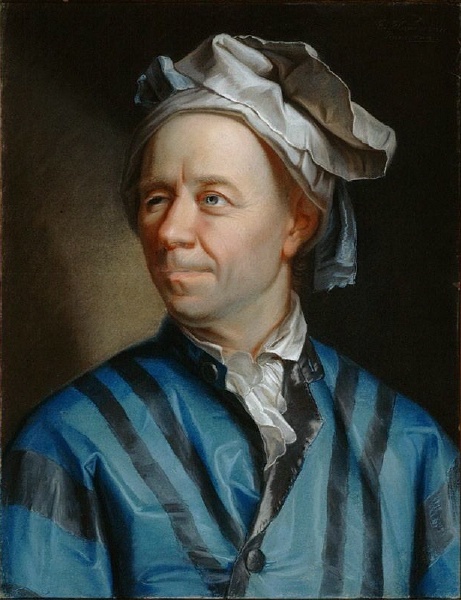
Leonhard Euler (1707–1783) was one of the most prolific and influential mathematicians in history. Born in Basel, Switzerland, in 1707, Euler spent much of his life working in Russia and Prussia, where he produced an astonishing volume of mathematical work that shaped countless fields, from number theory and graph theory to fluid dynamics and astronomy.
Early Life and Education
Euler's mathematical talents were recognized early. He studied under Johann Bernoulli, one of the foremost mathematicians of the time, and by his early twenties, Euler was already publishing groundbreaking papers. In 1727, he moved to the Imperial Academy in St. Petersburg, Russia, at the invitation of Empress Catherine I. There, he initially worked in physiology and naval science before turning fully to mathematics.
Later, Euler also served at the Berlin Academy under Frederick the Great, before eventually returning to St. Petersburg for the remainder of his life.
Mathematical Notation and Contributions
Euler’s contributions are so vast it’s difficult to encapsulate them all. He introduced much of the modern mathematical notation we still use today, including:
- The concept of a function written as \( f(x) \)
- The use of \( e \) for the base of the natural logarithm
- The symbol \( i \) for the square root of -1
His clarity in notation helped make mathematics more precise and expressive, influencing how future generations wrote and understood mathematics.
Euler’s Identity
One of Euler’s most famous contributions is Euler’s identity:
\[ e^{i\pi} + 1 = 0 \]This equation elegantly connects five of the most important constants in mathematics — \( e \), \( i \), \( \pi \), 1, and 0 — in a single relationship. It is often described as a "mathematical poem" for its beauty and simplicity.
Achievements in Number Theory
In number theory, Euler extended Fermat's work, introducing the Euler totient function and proving numerous results involving prime numbers. He also solved the famous Basel problem, determining that the infinite series of reciprocal squares converges to:
\[ \frac{\pi^2}{6} \]This result stunned the mathematical world and demonstrated Euler’s exceptional insight and creativity.
Contributions to Physics and Applied Mathematics
Beyond pure mathematics, Euler made major contributions to physics, particularly in mechanics and hydrodynamics. He formulated Euler’s equations governing the motion of fluids, worked on the theory of elasticity, and laid the foundations for the calculus of variations — a branch of mathematics essential in modern physics and engineering.
Work Despite Blindness
Amazingly, Euler continued producing world-class mathematics even after losing vision in one eye — and later becoming completely blind. His mental faculties remained as sharp as ever. He dictated entire volumes of mathematics while blind, relying on his incredible memory and computational skill.
It is estimated that Euler produced over 800 papers and books — a legacy unmatched by almost any mathematician in history.
Final Years and Legacy
Leonhard Euler passed away in 1783, reportedly after experiencing a brain hemorrhage shortly after discussing the orbit of Uranus. He left behind not just a towering body of work, but a legacy that would shape modern science, engineering, and mathematics.
Euler’s influence is so far-reaching that many of today’s mathematical tools, techniques, and notations owe their origins directly to him. From the simplest formulas to the most advanced theories, Euler’s ideas remain at the heart of mathematics.

All rights reserved by the Mathematical Unity
Contact: +8801400044645
Email: mathematicalhorse1453@gmail.com
Our Discord Server: Mathematical Unity [Ulus Riyadiyat]